Last Exit From Dystopia: Coda
Writing is the final resistance we have against the inhuman practices and injustices that disfigure human history. —Edward Said

As Inauguration Day 2025 approaches, memories of President-elect Donald Trump’s egregious mendacity and incompetence in dealing with the Coronavirus pandemic have raised anxiety levels among thoughtful Americans who have not yet succumbed to the amnesia epidemic incited by GOP gas lighting and mind control campaigns broadcast on Fox Snooze. The Atlantic columnist Peter Wehner, a lifelong Republican and contributing writer to the magazine, called Trump’s ineptitude “head snapping” when he issued this prescient warning back in 2016 at the outset of The Donald’s first term as president: “Mr. Trump’s virulent combination of ignorance, emotional instability, demagogy, solipsism and vindictiveness would do more than result in a failed presidency; it could very well lead to a national catastrophe. The prospect of Donald Trump as Commander-in-Chief should send a chill down the spine of every American.” One such American is actor Robert DiNiro who didn’t mince any words at such a prospect, stating on CNN, “This guy shouldn’t be president. Period.” Meanwhile, comedian Jimmy Kimmel, another media star in need of spinal chill relief said: “We have a crazy person running our country, and not only that, according to a Washington Post/ABC poll, all five top Democratic candidates are polling ahead of him.” Other categories polling ahead of Trump, Kimmel also noted, included bedbugs, Honey Boo-Boo and genital herpes.
Trump’s inability to tell the truth, a character trait earning him the sobriquet Dishonest Don, was a great source of mirth, and it’s true that a lot of the loony stuff he tweeted and said aloud at briefings was grist for the entertainment mills. The trouble is, Trump’s lies led to deadly serious consequences as the Coronavirus wreaked havoc on the nation. According to Scientific American, “In the final year of Donald Trump’s presidency, more than 450,000 Americans died from COVID-19, and life expectancy fell by 1.13 years, the biggest decrease since World War II.” Living in America with Trump in the White House, Robert DiNiro told Stephen Colbert, “Is like living in an abusive household. You don’t know what crazy thing is going to happen next. He’s a fake president; he calls everything fake because he knows he’s fake.” DiNiro isn’t bullshitting. As The Washington Post revealed on April 3, 2020, “In 1,170 days, president Trump has made over 18,000 false or misleading claims.” That number of Trump’s lies rose to over 30,000 by the 2020 election, including whoppers in what CNN called “the most dishonest speech of his presidency” delivered on Thursday November 5, as he teetered on the verge of defeat.
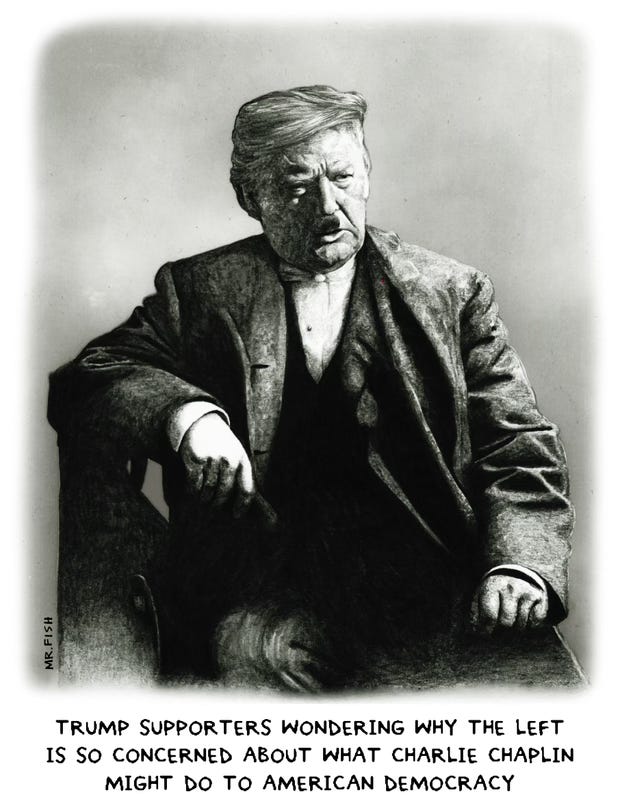
The Great Dicktator
Other critics of Trump’s performance as president included Heather Cox Richardson who wrote, “Urging Americans to plow headfirst into a deadly crisis that is racking up horrific numbers of dead is an unprecedented abdication of presidential leadership…Trump is doubling down on the idea that the United States must simply reopen, and take the resulting deaths as a cost of doing business.” This was just another contentious policy of a president who thought it was OK to scrap environmental policies already in place to produce clean energy and reduce air pollution. The White House’s then resident sociopath also favored rolling back legal protections for endangered species, increasing logging on public lands, dropping climate change from the list of national security threats, and diminishing the prosecuting power of the Environmental Protection Agency.
“Taken together,” Peter Wehner wrote in the March 7, 2020 Atlantic. “This is a massive failure in leadership that stems from a massive defect in character. Trump is such a habitual liar that he is incapable of being honest, even when being honest would serve his interests.” David Frum, also writing in The Atlantic, challenged Trump’s continual refusal to take responsibility for his lies and his administration’s poor management of the crisis. “That the pandemic occurred is not Trump’s fault,” Frum wrote. “The utter unpreparedness of the United States for a pandemic is Trump’s fault.” In a related Guardian interview, professor Noam Chomsky struck a particularly somber note in the chorus of indictments of the president’s performance when he said that Trump is culpable in the deaths of thousands of Americans because of his decision to cut funding for healthcare and infectious disease research in order to benefit wealthy corporations. “That’s something that Trump has been doing every year of his term, cutting back more…to make sure that the population is as vulnerable as he can make it, that it can suffer as much as possible, but will of course increase profits for his primary constituents in wealth and corporate power.”
Meanwhile, Fox News and other sycophantic elements of the media shamelessly helped Trump in his efforts to deflect blame. Just prior to the election the president brazenly congratulated himself in public for doing what he perceived as a great job, awarding himself a “ten,” while the real credit for confronting the crisis honestly and effectively belongs to the nation’s healthcare workers, scientists, food service employees and other critical personnel out on the front lines of the pandemic, people of integrity dedicated to the common good, working selflessly and courageously to get the pandemic under control. Their efforts are the valued expressions of democratic unity that New Yorkers celebrated at seven o’clock every evening when, as David Remick documented in The New Yorker, “In many neighborhoods across the city, cheering breaks out the way it would when the Yankees clinched another World Series title. It spills from the stoops and sidewalks, from apartment windows and roof tops, for all the nurses, orderlies, doctors, EMTs —everyone who cannot shelter in place and continues to go about healing the people of the city…cheering everyone who makes it possible for the city to avoid the myriad conceivable shortfalls and collapses: grocery clerks and ambulance drivers; sanitation workers; pharmacists and mail carriers; truckers, cops, and firemen.”
The cheering in the streets of the Big Apple, the American city hardest hit by the pandemic, is a salient example of how the Coronavirus raised awareness of what Dr. Martin Luther King, Jr. called “the inter-related structure of reality,” wherein “all men are caught in an inescapable network of mutuality, tied in a single garment of destiny.” If there was indeed a silver lining in this medical emergency, it was the peaceful working people united in community action, especially with a wanna be fascist sociopath like Trump in the White House, a man journalist Chris Hedges called “America’s version of Caligula.” As he now prepares to move back into the White House, elected by voters who have obviously been stricken by a virus far deadlier than the Coronavirus called the Stupid Virus, it’s worth remembering that after his first administration, Trump’s destiny was decided by King’s “network of “mutuality” in the form of the American electorate when his presidency “miraculously disappeared” as he often predicted would be the fate of the Coronavirus. Trump and his crime family were evicted from the White House by a substantial majority of voters in what pundits understatedly called the most important election in American history. Little did they know that history would soon repeat itself with another Trump presidency.
As we collectively contemplate this absurd outcome, we should bear in mind that his defeat in 2020 was preceded by a mental breakdown after he contracted the virus, blaming his infection on the families of fallen US service members with whom he attended a public event. During his recovery, his behavior was erratic, angry and chaotic, indicative of problems with the steroids he was taking. In a disturbing interview at the time with Rush Limbaugh in reference to Iran, the “Coronavirus-in-Chief” stated that “If you fuck around with us, if you do something bad to us, we’re gonna do things to you that have never been done before.” Trump’s churlish behavior drew widespread public reaction including political historian Matthew Dallek’s comment that America faced a “surreal situation” with a president that ignored health guidelines, calling such behavior “a recipe for…dystopia.” Incredibly, at least for the millions of voters who think Trump’s threats of retribution pertain only to people other than themselves and who insist on voting against their own interests, their perceptions led astray by wishful thinking, propaganda and demagogy, will have as the leader of their grim misadventure the petulant narcissist that Joe Biden recently welcomed back to the White House for a second term as President of the United States.

It is also important to remember that Trump’s first administration belies a deeper malfeasance of governance than the foibles and defects of one man. The first Trump presidency, as well as the one coming up, are symptoms of a systemic glitch that the Coronavirus event exposed and amplified. “The crisis has shown definitely that Trump’s presidency is not an aberration,” wrote Fintan O’Toole in the April 25, 2020 Irish Times. “It has grown on soil long prepared to receive it. The monstrous blossoming of misrule has structure and purpose and strategy behind it…There are very powerful interests who demand ‘freedom’ in order to do as they like with the environment, society and the economy.” O’Toole’s comments reflect Green Party member David McCorquodale’s warning that “because so little was known about the COVID-19 virus, people were looking to the “authorities” for direction, which leads back to the same old power structure that’s always in place. In fact, the leaders of many countries are using the crisis to intensify their grip on power, raising the danger that the outcome will be a more authoritarian world.” This is precisely what happened with Trump, who inadvertently became a symbol of the populist reaction against the political corruption that was well established long before he arrived on the scene. As Chris Hedges graphically states the case, “Trump isn’t the problem, he’s the puss coming out of the wound.” And as James Howard Kunstler has pointed out, “This age of battling narratives tends to conceal the broken consensus behind it. What’s gone is a broad social agreement that there are certain fundamental realities and the codes of conduct that follow from them.”
The “broken consensus behind it” that Kunstler alluded to has been deliberately compromised by neoliberal political maneuvers in order to weaken democracy, a process that got underway with a vengeance during the Reagan administration with assaults on unions, campaigns to eliminate Social Security, privatize the Postal Service, defund free education whilst piling debt on students and their parents, insane policies to staff regulatory agencies with people from the industries they’re supposed to regulate and rigging the electoral process in favor of Big Business. In short, the social trust established by FDR’s New Deal is being systematically destroyed in order to privatize the public realm for the exclusive benefit of the wealthy via the aforementioned strategies along with absurd laws such as Citizens United, an egregious perversion of morality that views money as free speech and insanely grants corporations more rights than human beings.
The tyranny of money in politics is anathema to democracy and the vision of the Good Life as outlined by the nation’s founders, which is why getting money out of the picture should be at the top of the legislative agenda. But in our plutocratic, anti-democratic government, enriching the top one percent and impoverishing the remaining 99% is the primary goal. Today, America has the worst economic inequality in history, a situation created by neoliberal bankers and corporations motivated by Adam Smith’s Vile Maxim — “All for ourselves and nothing for others.” Ever since the publication of tobacco industry lawyer Lewis Powell’s 1971 memo to the US Chamber of Commerce urging big business forces to fight back against activists like Ralph Nader and wage class war on American democracy, neoliberals have redesigned the economy in favor of financial institutions and corporate monopolies. The result has been a forty percent increase in corporate profit margins and a corroding decrease in American workers’ share of the wealth. What’s more, as Noam Chomsky points out, these elite corporate kleptocrats have cast an ugly policy shadow across the nation with management systems explicitly designed to shift the burden of taxes to the lower classes while reducing or eliminating taxes for the rich. To keep the rabble in line, they strive to manufacture consent with propaganda aimed at distracting people with materialistic temptations and the inane Hollywood spectacle of celebrity culture.
The whole nauseating process of “corporate subversion and sabotage of democracy,” is thoroughly documented in Ralph Nader’s indispensable book Breaking Through Power, an in-depth analysis replete with examples of the numerous ways the neoliberal capitalist/imperialist system favors corporate plutocrats at everyone else’s expense. Nader cites the corporate takeover of public resources for private gain, including the public airwaves that have been commercialized without regard to “public convenience, interest or necessity,” as the 1934 Federal Communications Act requires. He also examines the neoliberal attacks on Social Security, Medicare, and automobile safety standards and documents the relentless exploitation of natural public resources for corporate profit, the ruination of America’s educational system and the corruption of the judicial system that culminated in the antics of Attorney General William Barr who apparently saw himself as Donald Trump’s personal lawyer rather than the guardian of the rule of law for the whole nation. Also in the spotlight are the abuses of the military/industrial/congressional establishment that consumes more than half of America’s budget dollars, the egregious global rackets like NAFTA that exploit low-wage workers in the third world as well as the sub rosa machinations of the IMF, World Bank and WTO that enrich the CEOs of the multinational corporate giants. Nader explains at length how they avoid taxes and evade responsibility for the harm they cause to people and the environment.
“Their arrangement allows them to have it both ways,” writes Nader, “the advantages of our country without the responsibility of contributing to the nation’s upkeep and security.” Nader further notes that Robert McIntyre, director of Citizens for Tax Justice, found that “Every dollar in taxes companies avoid by using tax havens must be balanced by higher taxes paid by other Americans, cuts to government programs, or increased federal debt.”
America has become a vast, chaotic, “gangster empire,” as author Robert Harris characterized Rome in its decline. In ecological terms, we have reached the “overshoot” point described by William Catton where the natural resource “carrying capacity deficit” of the planet imperils our very survival. It has never been more imperative that unfettered capitalism, the driving force of global consumerism, a pathological economic system “by which the living is converted into the dead,” as Derrick Jensen described it, be dismantled. Resistance is a necessity, not an option, if we are to survive. In the face of these harsh realities, professor Paul Street poses the most relevant question of our time in his important book They Rule: The 1% VS. Democracy. “What might and should be done in the interest of restoring or introducing democracy to the United States and saving civilization from catastrophe? In Ralph Nader’s view, “Expectation levels — what Abraham Lincoln called the all important ‘public sentiment’ — need to change in order to win back control of society from the One Percenters and the corporations that will continue to contaminate the Earth until it is poisoned, let it warm until it is barren and also will lie until they are caught and brought to justice. We have the tools we need to do the job if we’re willing to make the effort to reclaim them. Lincoln’s ‘public sentiment,’ is the ignition switch for change.”
Nader makes the case that we, the people, have the power to reclaim our anemic democracy that the rich seek to destroy. One fact in our favor is that there are far more of us than there are of the fat cats living off our labor. All we need is the collective will. Nader emphasizes throughout the book that we have the power granted us by the Constitution to take the necessary initiatives now. “Undermined as it has been by decades of deregulation and privatization,” he points out, “democracy still exists in the United States, and its participatory and egalitarian mechanisms for civil rights, social change, and justice remain our best tools for confronting the power structure and changing it.” He presents several inspring examples of individuals who led efforts to empower democracy, including the story about writer/activist Bill McKibben, founder of 350.org, the man Nader describes as “Arguably the big oil, gas and coal companies’ biggest nightmare.” Under McKibben’s direction, 350.org’s global climate action event, what CNN called “the most widespread day of political activity in the planet’s history,” got the message across that the threshold level of carbon dioxide in the atmosphere is three hundred and fifty parts per million. Although CO2 levels now exceed three hundred and eighty parts per million, a number projected to reach four hundred and fifty ppm by 2035, McKibben and company believe it can be reduced below 350 ppm by phasing out coal-burning plants, planting trees on a massive scale and ramping up alternative energy technologies. The 350.org movement is a powerful example of Nader’s contention that, “It is the initiatives of deeply caring, regular people that provide the firmament for our democracy.”
Nader’s knowledgable assessment is inspiring, but it seems unlikely at this late hour that the law enforcement authorities of our dying Republic will rise to the solemn, auspicious occasion of freedom’s demise to honor their allegiance to the Constitution and hold Trump and his fascist horde accountable for their crimes against democracy, humanity and the aspirations of liberty as set forth in the Declaration of Independence. As I write, the officials of our corrupt government are caving one by one in fealty to the rabble of traitors who worship the power of Mammon instead of serving the virtues of truth and justice they swore to uphold. Sadly, appeasement appears to be the order of the day for high government officials, unprincipled GOP congress members and corporate leaders such as Facebook’s Mark Zuckerburg who donated $1 million to Trump’s inaugural fund, as these Neville Chamberlain wannabes acquiesce to Trump’s threats and abandon the protocols of democracy and the rule of law. Robert Hubbell spells out the nauseating capitulation process in detail in the December 12 Today’s Edition Newsletter with the focus on FBI director Christopher Wray’s resignation. Hubbell reports in part:
Wray has served honorably for seven years — until Wednesday. On Wednesday, he told the men and women of the FBI that the proper course of action in the face of tyranny is surrender.
That is a dangerous message at the very moment that Trump is promising to convert the FBI into a personal political force for the president. Wray’s message was “Let him do it. Surrender. Avoid controversy. Protect yourself, not the Constitution.” To be clear, he didn’t say those words. His actions did.
Wray claimed that he was resigning to spare the FBI further controversy.
Appeasement never works.
Unlike Neville Chamberlin, Wray learned immediately that his efforts to calm the waters failed. Before Wray’s words had ceased echoing through the halls of the FBI, Trump was heaping abuse (and lies) on Wray and FBI agents who did their duty.
The collective collapse of Washington insiders to Donald Trump is dispiriting and infuriating. The “go-along-to-get-along” attitude elevates personal relationships and political longevity in Washington, D.C., at the expense of the rule of law .
Like Merrick Garland, Wray’s announcement made clear that he was concerned, first and foremost, for the department he served. The Constitution came second, and the American people were last.
It is a dark and foreboding time in America as we watch our leaders bow in fealty to a fascist clown, leaving ordinary citizens in the lurch, but as the long arc of history attests, for all their zeal to protect themselves and in that process endanger the blessings of liberty bestowed by the Constitution, and despite their concerted efforts to expunge the deeds of their fascist quest from the official record, in the end they will fail. The stench of their moral bankruptcy and cowardly acquiescence to the demands of autocrats and billionaires will seep into every American institution, every stone of the nation’s historical monuments, every seat in the boardrooms of its corporate enterprises and every living room of its citizens’ homes as an eternal reminder of the Republic’s betrayal by Trump and the jackals of capitalist greed.
But all is not lost; with officialdom gone fascist, it is now up to us, the citizens of our imperiled Republic, to resurrect the protocols of liberty that have defined, not only what it means to be an American, but more importantly, a true citizen of a planet where all beings have the inalienable right to live in peace and harmony. “Small acts,” said the great activist Howard Zinn, “when multiplied by millions of people, can quietly become a power no government can suppress, a power that can transform the world.” Pulitzer Prize winning journalist Chris Hedges, author of The Death of the Liberal Class; America: The Farewell Tour, and many other great books says this country is a tinder box waiting for the spark that sets things off. The economic crisis caused by the pandemic has shone a piercing light on the corruption of America’s plutocratic economy, a predatory racket managed by a corporate class of grifters and kleptocrats for the exclusive benefit of a few hundred obscenely rich people who don’t feel any empathy whatsoever for the vast majority of their fellow Americans forced to live paycheck to paycheck. “The longer we pretend this dystopian world is not imminent, the more unprepared and disempowered we will be,” Hedges writes. “The ruling elites’ goal is to keep us entertained, frightened and passive while they build draconian structures of oppression grounded in this dark reality. It is up to us to pit power against power, ours against theirs. Even if we cannot alter the larger culture, we can at least create self-sustaining enclaves where we can approximate freedom. We can keep alive the burning embers of a world based on mutual aid rather than mutual exploitation and this, given what lies in front of us, will be a victory.”
Stewart, this is an exceptional piece of writing — thoughtful, detailed, and unflinchingly honest. You’ve woven together critical perspectives and historical context to offer a searing critique, while highlighting the deeper systemic issues at play. Your ability to cite powerful voices and juxtapose their insights with sharp analysis is truly commendable. Well done on capturing the urgency of these times with such clarity and conviction!
I hope you are well and have a wonderful holiday season. -Mel (coffee barista)
I reiterate Melanie's comment Stew, a truly exceptional piece both in content and also in the 'scariness' of your (and the World's) situation. Unfortunately I now have the image of a Darth Vader figure controlling or trying very hard to control EVERYTHING - we can only hope for an appearance from 'The Force' to counteract the impending or potential disaster to come!
A very Happy Christmas to all who might be reading this and fingers crossed that the nightmare scenario that's possible doesn't in fact manifest itself.